Get Free Consultation!
We are ready to answer right now! Sign up for a free consultation.
I consent to the processing of personal data and agree with the user agreement and privacy policy


We are online 24/7
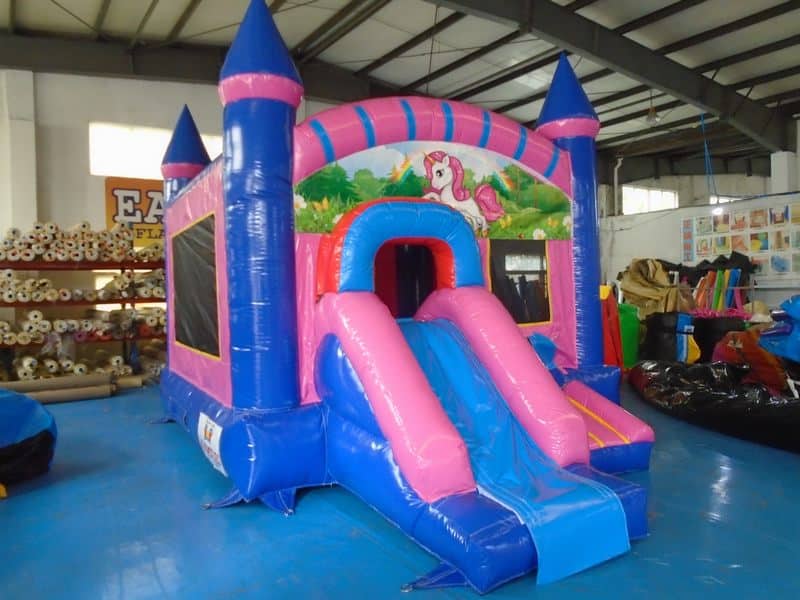
Stability is one of the most immediately noticeable differences between bounce houses. Even before users begin jumping, a bounce house can feel either secure and grounded—or slightly unstable and unpredictable. This perception forms within seconds, and once confidence is lost, it rarely returns.
What many buyers do not realize is that stability has little to do with appearance or size. Instead, it results from a combination of design decisions that influence how the structure interacts with weight, movement, and airflow during use.
The base of a bounce house determines how it interacts with the ground. A wider, reinforced base spreads weight more evenly and lowers the center of gravity. This creates a grounded feel that remains consistent even when multiple users jump at the same time.
In contrast, narrow or lightly reinforced bases concentrate stress in fewer areas. Under load, these bases shift more easily, causing subtle movement that users perceive as instability.
This difference becomes especially noticeable during high-energy use, such as birthday parties or rental events.
Many buyers assume that more anchor points automatically mean better stability. In reality, placement matters far more than quantity.
Well-designed bounce houses position anchor points at locations that counteract lateral movement and vertical lift. Poorly positioned anchors may restrict movement in one direction while allowing excessive motion in another.
Over time, incorrect anchoring also places uneven stress on seams and panels, further reducing stability.
Stability is closely tied to how quickly a bounce house recovers air pressure after impact. Each jump briefly displaces air. A well-matched blower and air channel system restores pressure almost instantly.
When airflow is insufficient or uneven, pressure recovery lags. This creates a soft, unstable feeling underfoot—even though the bounce house remains fully inflated.
This issue often appears only during active use, which is why it is rarely mentioned in basic specifications.
Stability is not about eliminating movement entirely. A bounce house must absorb energy while maintaining control.
Reinforced stress zones, especially along seams and corners, prevent excessive deformation during use. Without reinforcement, panels flex independently, causing the structure to feel loose or unpredictable.
Experienced manufacturers design bounce houses to move with energy rather than against it.
Stability also affects long-term durability. Structures that shift excessively place repeated stress on seams and anchor points, accelerating wear.
Bounce houses that feel stable tend to maintain shape longer, resist seam fatigue, and require fewer repairs over time.
Manufacturers with long-term commercial experience—such as experienced manufacturers like East Inflatables—often design stability into the structure rather than relying on external fixes.
If one bounce house feels stable while another does not, the reason lies in base design, anchoring strategy, airflow management, and reinforcement—not size or appearance.
Buyers who understand this avoid products that feel unstable on day one and deteriorate quickly thereafter.
